The silence — and in many cases, the open enthusiasm — of institutionalized journalists toward the Chartered Institute of Media Professionals (CIMP) Bill is a political scandal that must be exposed. Rather than recognizing the bill as a direct assault on their own democratic rights, a significant layer of established media professionals has greeted it as an opportunity for personal advancement. They see in the Chartered Institute not a cage, but a club: a state-operated institution that will certify their professional status, distinguish them from the unwashed masses of “content developers” and social media commentators, and — most importantly — open the door to the material privileges that state recognition can confer. Pensions. Insurance schemes. Bank loans at preferential rates. Foreign visa facilitation. Access to government advertising and contracts. A seat at the table with the powerful.
This is the outlook not of defenders of press freedom but of a privileged petty-bourgeois stratum seeking to secure its position through collaboration with the capitalist state. It is the mentality of the courtier, not the journalist.
The Bribe and the Chain
On 17 February 2026, Deputy Minister of Mass Media Kaushalya Ariyarathna of NPP/JVP government told Parliament that the government would establish a chartered institution to promote journalists’ job security, professionalism, health insurance and welfare, and that it would continue the scholarship schemes.
The Dissanayake government is not offering these inducements out of generosity. It is executing a classic strategy of bourgeois statecraft: buy off a strategic layer of the profession, bind their material interests to the survival of the regime, and in doing so, fragment any potential opposition to the throttling of democratic rights. The journalist who today receives a state-certified accreditation, a facilitated bank loan, or a government pension scheme becomes, tomorrow, a hostage. The same state that grants these privileges can revoke them — and under the CIMP Bill, the mechanism for revocation is already built into the architecture. Section 24 empowers the Council to “disenroll any member” for “professional misconduct,” a term left deliberately undefined in Section 23(2), to be filled in later by rules made by the same Council. The journalist who believes they are securing a pension is in fact putting their head in a noose.
This is not hypothetical. We have seen this dynamic play out repeatedly. In 2023, the Government Medical Officers’ Association — the trade union of Sri Lankan doctors — agreed to government censorship* of its own members’ communications, demonstrating how professional associations function as the industrial police for government and corporations. The union bureaucrats who negotiate such arrangements secure their own positions at the expense of the rights of their members. The CIMP Bill extends this model to journalism: create a chartered body, staff it with compliant figures, and use it to discipline the profession from within.
The Class Character of the Betrayal
The journalists who welcome the CIMP Bill are not acting out of ignorance. They are acting out of class interest — the interest of a privileged layer that fears the independent mobilization of the working class and the unregulated democratic discourse of the internet more than it fears state censorship. The mainstream corporate media in Sri Lanka is already tightly controlled by oligarchs and the state. Its senior practitioners have long since made their peace with power. What terrifies them is not the government’s repression but the rise of independent online media — the bloggers, the social media commentators, YouTubers, the citizen journalists, the socialist publications — who operate outside the established hierarchies of the profession and who give voice to working-class anger against IMF austerity, privatization, and imperialist war.
The CIMP Bill, by bringing “content developers” under the disciplinary apparatus of the state, promises to eliminate this competition. For the institutionalized journalist, the bill is not a threat to press freedom — it is a moat around their professional castle. They will be certified. Their rivals will be disenrolled. The democratic right of free expression will be converted into a licensed privilege, and they will be among the license-holders.
This is a reactionary posture of the most dangerous kind. It is the same mentality that led the trade union bureaucracy to suppress strikes by postal workers, electricity workers, and health workers — sacrificing the interests of the broader working class to preserve their own positions within the state apparatus. It is the mentality of the labor aristocracy, the privileged stratum that imperialism cultivates in the colonial and semi-colonial countries to serve as a transmission belt for the dictates of finance capital.
A Trap, Not a Shelter
The journalists who imagine they will benefit from the CIMP Bill are deluding themselves. The state that grants privileges can withdraw them. The Interim Council appointed by the Media Minister — consisting of the Ministry Secretary and six political nominees — will write the rules that define “professional misconduct.” Those rules will not be written to protect the integrity of journalism. They will be written to silence criticism of the government. The journalist who accepts accreditation today may find themselves disenrolled tomorrow for reporting on a strike, exposing a corruption scandal, or publishing an article critical of the IMF program. The pension, the bank loan, the visa facilitation — all will vanish the moment the journalist steps out of line.
The only reliable guarantee of press freedom is not a state-issued certificate of professionalism. It is the organized power of the working class. The journalists who seek to insulate themselves from state repression by collaborating with the state will find that they have merely made themselves more vulnerable to it. They will have traded their independence for a mess of pottage, and they will be devoured in due course.
Journalists Must Ally with the Working Class
The Socialist Lead of Sri Lanka and South Asia (SLLA) calls on all honest journalists — including those who may have initially viewed the CIMP Bill as an opportunity for professional advancement — to break decisively from this reactionary orientation. The fight against the CIMP Bill is not a fight for the privileges of a professional elite. It is a fight for the democratic rights of the entire working class, of all the “content creators”. Journalists cannot defend their right to publish by seeking patronage from the capitalist state. They can only defend it by allying themselves with the class that has the power to overthrow that state.
Reject the bribe! The government’s promise of insurance, pensions, loans, and visas is the price of your chains. No material inducement is worth the surrender of press freedom!
Break from the institutionalized journalists who are collaborating with the state! Their “professionalism” is a cover for class betrayal. They do not speak for journalism — they speak for their own careers!
For the unity of journalists with the working class! The fight for press freedom is inseparable from the fight against IMF austerity, against imperialist war, and for the socialist reorganization of society!
Build rank-and-file committees of media workers! Independent of the corporate media owners, the trade union bureaucracy, and the state — to fight for the right to publish without interference!
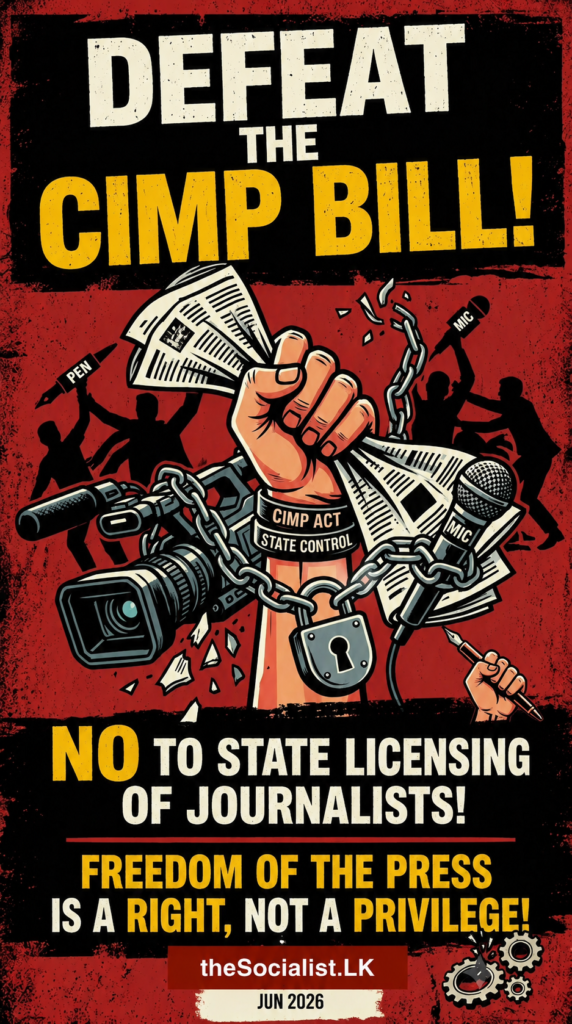
Defeat the CIMP Bill! No to state licensing of journalists! Freedom of the press is a right, not a privilege!
The pen that serves the state will be broken by the state. The pen that serves the working class will be defended by the working class. Journalists must choose which side they are on.
By Sanjaya Jayasekera, Editor, theSocialist.LK | Member, the Socialist Lead of Sri Lanka and South Asia (SLLA).
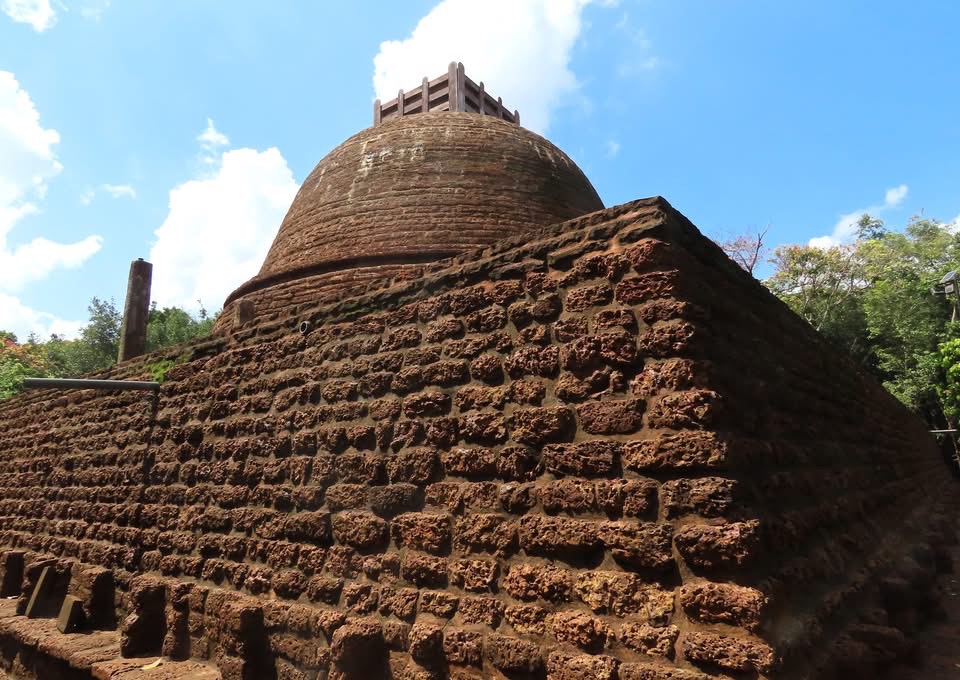
Kurunthurmalai (Kurundi Archaeological Site) in Mullaitivu has become a severe ethnic flashpoint, with Tamil nationalist leaders condemning state-backed efforts to erase their claims to traditional Tamil ownership and the ancestral Athishivan Aiyanar worship at the site. Conversely, the Sri Lankan Department of Archaeology and Buddhist monks invoke majoritarian chronicles to claim the hill exclusively as an ancient Buddhist reserve, weaponizing heritage preservation to seize surrounding lands and prohibit Tamil worship. Image from Facebook
The ruling classes of every epoch have reached into the past to justify the crimes of the present. When the political and ideological representatives of the bourgeoisie invoke ancient scriptures, chronicles, and mythological epics — the Hebrew Bible, the Vedas, the Ramayana, the Mahavamsa — to claim territories, dispossess living peoples, and incite communal violence, they are not engaged in a scholarly recovery of history. They are performing a class function: converting the contested and often mythological record of the distant past into a weapon against the working class in the present.
The working class must categorically reject this reactionary logic on principled grounds. No event from millennia past — no migration, no conquest, no divine promise inscribed in a religious text — can constitute a legitimate claim against the rights of communities living today. The decisive criterion is not what allegedly occurred in the age of myth or chronicle, but the incontestable right of populations to the lands they actually inhabit in the present and in recent history. To displace, dispossess, or delegitimize a living people on the basis of a text of contested authorship and indeterminate antiquity is not the recovery of historical justice — it is the manufacture of present injustice in the name of the irretrievable past.
This principle is confirmed, not contradicted, by the broader record of human civilization. The legacies of ancient Rome, Greece, Mesopotamia, and Egypt are not the exclusive national property of the contemporary states that occupy those territories. They are the common inheritance of all humanity. Civilizations across recorded history determined their reach through conquest, displacement, and war — methods which the modern world, through hard and bloody experience, has recognized as barbaric and repudiated in international law. The Westphalian principle of territorial sovereignty, and the post-1945 international legal order built upon it, rest precisely on the recognition that conquest confers no permanent title, and that the rights of present populations cannot be overridden by the claims of the dead over the living.
It is therefore not merely wrong but utterly reactionary — a politically manufactured regression — to label communities as “invaders” on the basis of ancient texts, or to evict them from lands they have inhabited for generations on the grounds that a scripture or chronicle awarded those lands to someone else. The myths and narratives contained in the Old Testament, the Vedas, the Mahavamsa, or the Ramayana are part of humanity’s literary, spiritual, and intellectual heritage. They are not title deeds. Their selective appropriation by any ethnic or religious group to justify present-day dispossession is not a defence of identity — it is the exploitation of the past in the service of a definable and identifiable class interest in the present.
The Core Logic: Whose Interests Does It Serve?
The starting point of any serious political analysis of this abuse of history is not “is this historically accurate?” but rather “who benefits from this narrative, and why now?” When ruling classes in South Asia reach back millennia into myth, chronicle, or scripture to manufacture territorial or ethnic claims, they are not engaging in scholarship — they are performing a class function. They are diverting the rage and anguish of exploited workers and peasants, who face mass unemployment, dispossession, caste degradation, and social collapse, away from the class enemy at home and toward a manufactured communal enemy.
This is the essence of what Marxists call communalism: the mobilization of religious or ethnic identity to mask class antagonisms. The Vedas, the Ramayana, the Mahavamsa, the Mahabharata and Torah did not spontaneously leap into political life. They were conjured there by ruling elites at precise historical moments when class contradictions sharpened to the point of threatening bourgeois order.
India: Hindutva, Ancient Myths, and the Fascist Project
The most developed and dangerous example in South Asia is the project of Hindutva — the Hindu supremacist ideology pioneered by V.D. Savarkar and institutionalized through the RSS (Rashtriya Swayamsevak Sangh) and its political arm, the BJP (Bharatiya Janata Party). The BJP-RSS nexus [1] is not a religious movement but a political one — rooted in the interests of a section of the Indian bourgeoisie that found secular nationalism too broad, too accommodating of the Muslim minority, and too threatening to its social hierarchy.
The Hindutva project rests on the claim that the Indian subcontinent is essentially, primordially, and eternally a Hindu civilization — and that Muslims, Christians, and others are therefore either foreign intruders or permanent guests with no legitimate roots. This mythology is constructed directly from ancient texts and religious narratives: the Vedas as “original” Indian civilization, the Ramayana as a historical record of Ram’s territorial dominion, the Mahabharata as a founding epic of Hindu nationhood. The mythology serves a precise political purpose — to retroactively delegitimize the presence of 200 million Muslims who have lived on the subcontinent for over a thousand years and whose ancestors were, in the vast majority, not “invaders” at all but local converts.
The most revealing concrete expression of this was the Babri Masjid campaign. The Vishwa Hindu Parishad (VHP) and BJP argued that the 16th-century mosque in Ayodhya had been built by the Mughal emperor Babur on the birthplace of the mythological Ram — a site identified on the basis of a text of dubious historicity. In 1992, a BJP-orchestrated mob tore down the mosque, triggering nationwide pogroms that killed thousands. Three decades later, India’s Supreme Court, in what the World Socialist Web Site (WSWS) rightly called an act of judicial capitulation to fascism [2], awarded the site to the Hindu communalists, and in January 2024, Modi personally inaugurated [3] the new Ram temple in a spectacle explicitly designed to fuse state power, religious myth, and electoral mobilization ahead of the 2024 general election.
What is happening here is precisely what we stated above: a myth — in this instance, not even a verified historical claim, but a story from a religious epic — is transformed into a territorial deed. Ram’s “birthplace” in a text of unknown authorship becomes grounds for demolishing a standing structure inhabited for centuries and dispossessing a real community living in the present. This was placing one historic crime atop another — the 1992 mob demolition being the first, and the 2024 state sanctification of it the second. The ruling class has not merely tolerated this political theology; Modi and the BJP have made it the organizing principle of the Indian state.
The class function is transparent. As the WSWS noted, “Modi and his BJP have ratcheted up their communalist offensive as the social crisis has deepened.”[4] India under Modi has seen accelerating inequality, mass unemployment, the devastation of peasant livelihoods (hence the enormous farmers’ protests), and the catastrophic mismanagement of the COVID-19 pandemic. The louder the Hindutva mythology, the more the BJP needs to silence the class questions underneath it.
Furthermore, the imperialist powers — Washington, London, and others — have not only tolerated but embraced this. The Hindu rashtra project—transforming India from a constitutionally secular republic into an explicitly Hindu nation— is not an obstacle to global capital; it is perfectly compatible with it, because it disciplines, divides, and suppresses the Indian working class while keeping India safely within the orbit of US geopolitical strategy. Ancient mythology in the service of communalism is, in this sense, also in the service of imperialism.
Pakistan and the Region: Partition and Its Legacies
The entire Indian subcontinent was reshaped by the catastrophe of the 1947 Partition — itself a product not of inevitable ancient hatreds between Hindus and Muslims, but of the specific political choices of the Indian bourgeoisie (Congress), the Muslim League, and above all the British imperialists, who used divide-and-rule as the mechanism of their exit. The “two-nation theory” — the claim that Hindus and Muslims constitute two fundamentally separate nations that cannot coexist — is precisely the logic our argument critiques: it takes religious and cultural difference and makes it an ontological, quasi-historical, territorial destiny. It was politically manufactured, not historically inevitable. And the consequence — over one million dead in weeks, fifteen million displaced — was entirely real and entirely contemporary.
The legacies of that choice continue to generate the nuclear standoff between India and Pakistan, the perpetual wound of Kashmir, and the periodic eruption of communal violence within India itself. Every BJP-orchestrated anti-Muslim pogrom — Gujarat 2002, the Citizenship Amendment Act (CAA) protests of 2019-20, the ongoing persecution of Muslims through mob violence and “love jihad” anti-conversion laws — is a continuation of that logic: the use of religious identity to territorialize, to mark populations as belonging or not belonging, to claim that some people’s present habitation is illegitimate because of the distant past.
Zionist Israel’s “Promised Land” Myth as a political weapon
The case of Zionist Israel is perhaps the most consequential, and certainly the most intensely debated, instance of the phenomenon analyzed throughout this essay — the weaponization of ancient religious texts to justify the dispossession, subjugation, and now the genocidal destruction of a living people in the present.
Zionism’s founding mythology rests on the proposition that the Hebrew Bible (Tanakh) — the Old Testament, the Torah — constitutes a divine land grant to the Jewish people — a title deed that supersedes the rights of those who have actually inhabited Palestine for centuries. The territory of historic Palestine was, according to this reading, “promised” by God to the Jewish people. Crucially, Zionism’s origins were secular: Theodor Herzl’s project was a bourgeois-nationalist response to European antisemitism, and the biblical connection was instrumentalized purely for political utility, to mobilize a geographically dispersed population around a cohering myth.
Over decades of state-building, however, this secular nationalist project was transmuted into a theologically and racially supremacist one. The settler movement — which now holds direct governmental power through Itamar Ben-Gvir’s National Security Ministry and Bezalel Smotrich’s Finance Ministry — operates entirely within the framework of biblical land entitlement [5]. The settlers do not argue in the language of post-1948 international law, or of UN resolutions, or of the Westphalian system. They argue in the language of Genesis and Joshua. The map of “Greater Israel” encompasses Lebanon, Jordan, and parts of Syria, Saudi Arabia and Iraq. It is the explicit territorial program derived from maximalist readings of the biblical Promised Land. The Palestinians “should leave and go to other countries,” Settler leader Daniella Weiss declares. The entire civilian population of Gaza is to be expelled to make way for Jewish settlement — “Our mission is to settle Israel.” Weiss dismisses the argument that this act is a war crime by referring to it as “a light felony.” In this worldview, international law is simply irrelevant: a divine mandate cannot be constrained by “the whims of legislation”. Ancient scripture trumps the entire post-1945 international legal order constructed to prevent a repetition of the Holocaust.
Netanyahu’s invocation of the Amalek doctrine — an Old Testament commandment for total extermination of the Amalekites — to kill every man, woman, child, and infant, and to spare nothing — as justification for the Gaza assault represents this theology in its most operationally explicit form [6]. The “Theology of Revenge” elaborated by Meir Kahane, brought into the highest levels of state power, frames Palestinians as a mythical enemy whose destruction is a religious obligation. This application of a biblically-grounded, racially supremacist, exterminationist ideology to a real, living civilian population is nothing but fascism.
The Nakba of 1948, in which 750,000 Palestinians were violently expelled through at least 31 documented massacres [7], represents the foundational material translation of this mythology. The systematic weaponization of antisemitism charges to silence criticism constitutes what the ICFI identifies as semantic inversion — suppressing the most principled traditions of the Jewish workers’ movement itself, which was overwhelmingly internationalist and socialist rather than Zionist.
The Marxist analysis [8], however, insists that the Hebrew Bible is not the cause of genocide but its ideological cover. Zionism from inception served imperial interests — from the Balfour Declaration to Israel’s current role as a garrison state for US imperialism. The only genuine alternative is the unity of Jewish and Arab workers in a unified socialist state, which alone can break the chains that nationalist mythology forges for all.
Sri Lanka: The Mahavamsa and the Catastrophe of Sinhala Buddhist Supremacism
The post-colonial history of Sri Lanka stands as a blood-stained testament to the weaponization of history in the service of capitalist class rule.
The island of Sri Lanka has never been, at any point in its recorded history, the exclusive domain of a single ethnic or religious civilization. Its ancient history is one of continuous migration, cultural interchange, and political entanglement between Sinhala-speaking and Tamil-speaking peoples, between Buddhist and Hindu traditions, between the island’s populations and those of the South Indian subcontinent. Any claim to ethnic exclusivism is not merely politically reactionary — it is historically illiterate.
The Mahavamsa — the ancient accretive, redactional Pali chronicle, compiled by monk Mahanama in the 5th century CE, and subsequently continued in the Culavamsa — is the primary literary source through which Sinhala Buddhist supremacism constructed its founding mythology. It presents the island as the divinely ordained sanctuary of the Buddhist Dhamma, with the Sinhalese as its appointed guardians. Sinhala Buddhist supremacism rests on the implicit claim that Tamils in Sri Lanka are essentially a recent foreign implantation, a product of invasions and migrations from South India that disrupted an originally Sinhala Buddhist civilization. The historical record, including the Mahavamsa itself, demolishes this claim. Tamil-speaking and Dravidian peoples had a presence in the island that is contemporaneous with, and in some respects antedates, the Sinhala Buddhist cultural formations that the chronicle celebrates. The island’s ancient history was one of thoroughly entangled Sinhala-Tamil interaction, and the ancient kingdoms were constituted across ethnic lines that were fluid, not fixed. The Mahavamsa’s own hero, Dutugamunu (161–137 BCE), fought his celebrated war against the South Indian king Elara with Tamil commanders in his army — and had Elara buried with full honors. The chronicles record Tamil kings ruling Anuradhapura, South Indian mercenaries serving Sinhala rulers, and Buddhist monasteries receiving Tamil patronage. Archaeological evidence from Anuradhapura includes Tamil-language Brahmi inscriptions from as early as the 3rd century BCE, testifying to a multilingual, multi-ethnic urban community at the very outset of recorded history. The ethnic boundary that supremacism projects onto ancient history simply did not exist in the form it requires.
Into this already complex historical landscape, Sinhala supremacists have inserted the Kalinga Magha invasion of 1215 CE as their most potent political weapon. According to the Culavamsa, Magha was a prince from Kalinga — modern coastal Odisha in eastern India — who arrived with a large mercenary force, captured Polonnaruwa, and ruled for approximately two decades. The chronicle records systematic devastation: the destruction of Buddhist temples, persecution of monks, and the collapse of the elaborate northern irrigation civilization. The demographic consequence was catastrophic — a mass southward migration of the Sinhala population, the abandonment of the great hydraulic infrastructure of the northern dry zone, and the permanent shift of Sinhala Buddhist civilization toward the island’s southwest.
The supremacist argument constructed upon this event runs as follows: the north and east was originally Sinhala Buddhist territory; the Kalinga invasion destroyed that civilization and created a demographic vacuum subsequently filled by Tamil settlers from South India; therefore the Tamil claim to a “traditional homeland” in the north and east is historically fraudulent, and the Sinhala state is historically entitled to assert sovereignty over those territories.
Every element of this argument is a falsification. First, Kalinga Magha was not Tamil. His army was a multilingual mercenary force recruited from across the subcontinent — Keralans, Chola soldiers, various South Indian contingents. To retroactively brand his invasion a “Tamil” conquest is a 20th-century political projection onto a 13th-century reality in which such ethnic categories carried no such meaning. Second, the Tamil presence in the north and east long predates 1215 CE. Archaeological and inscriptional evidence establishes continuous Tamil-speaking habitation in the Jaffna peninsula going back at minimum to the early centuries of the Common Era. The Chola kingdoms had maintained settlements and networks in the north for centuries before Magha’s arrival. The Tamil kingdom of Jaffna emerged from an already-existing population, not from a post-invasion colonial implantation. Third, and most decisively: even if the demographic argument were entirely conceded, it would provide no political or legal foundation whatsoever for present dispossession. The Tamil communities that built their civilization in the north and east over the subsequent centuries — constructing the Jaffna kingdom, developing Tamil literature and learning, establishing agricultural communities across generations — possess an incontestable claim to those territories grounded in centuries of actual, documented, continuous habitation.
The Mahavamsa was the ideological reservoir from which this communalism drew its cultural legitimacy. The story of Dutugamunu’s war against Elara — rewritten in the supremacist reading as a heroic Sinhala Buddhist struggle against Tamil invasion — became the template for presenting the island’s entire political history as an eternal civilizational conflict between Sinhala Buddhism and South Indian/Tamil aggression. The Kalinga Magha invasion fitted neatly into this framework: here was documented proof, from the chronicle itself, of a catastrophic invasion from India that had “destroyed” the Sinhala civilization of the north. The 800-year gap between 1215 and the present, during which Tamil communities had built their own deep-rooted civilizational presence in those territories, was ideologically collapsed — rendered irrelevant by the supremacist insistence on the “original” Sinhala claim. To argue that one medieval displacement justifies a contemporary dispossession is precisely the reactionary logic this entire essay demolishes. Projecting present-day ethnic categories of “Sinhala territory” and “Tamil territory” onto the pre-modern past is an anachronism that falsifies the actual historical record.
The modern political operationalization of this mythology was a deliberate ruling-class construction, not an organic cultural development. The Buddhist revivalist movement of late 19th-century colonial Ceylon was organized by wealthy Sinhala landowners and businessmen who felt threatened by the colonial hierarchy’s preference for the English-educated, Christianized elite. Their principal ideologue, Anagarika Dharmapala, fashioned from the Mahavamsa an ideology proclaiming the Sinhalese a unique Aryan race — an ideology whose followers in the 1930s explicitly invoked Nazi racial doctrine [9]. The decisive political deployment came in 1956, when S.W.R.D. Bandaranaike, confronted with the revolutionary potential of unified Sinhala-Tamil working-class struggle demonstrated in the 1953 hartal, reached for communalism as the only available weapon against socialist internationalism. The “Sinhala Only” Official Language Act transformed communal tendency into state doctrine, systematically excluding Tamils from public employment, higher education, and civic life.
The only alternative to the communalism of the ruling class was provided by the Lanka Sama Samaja Party (LSSP), which had, through the 1940s and into the 1950s, built a genuinely unified working-class movement across communal lines on the basis of socialist internationalism. It was precisely the subsequent degeneration and betrayal of the LSSP — culminating in its joining the bourgeois SLFP coalition government of Sirima Bandaranaike in 1964, and its co-authorship of the 1972 constitution enshrining Sinhala Buddhism as the state’s official foundation — that removed the working-class alternative and allowed communal ideology to fill the vacuum.
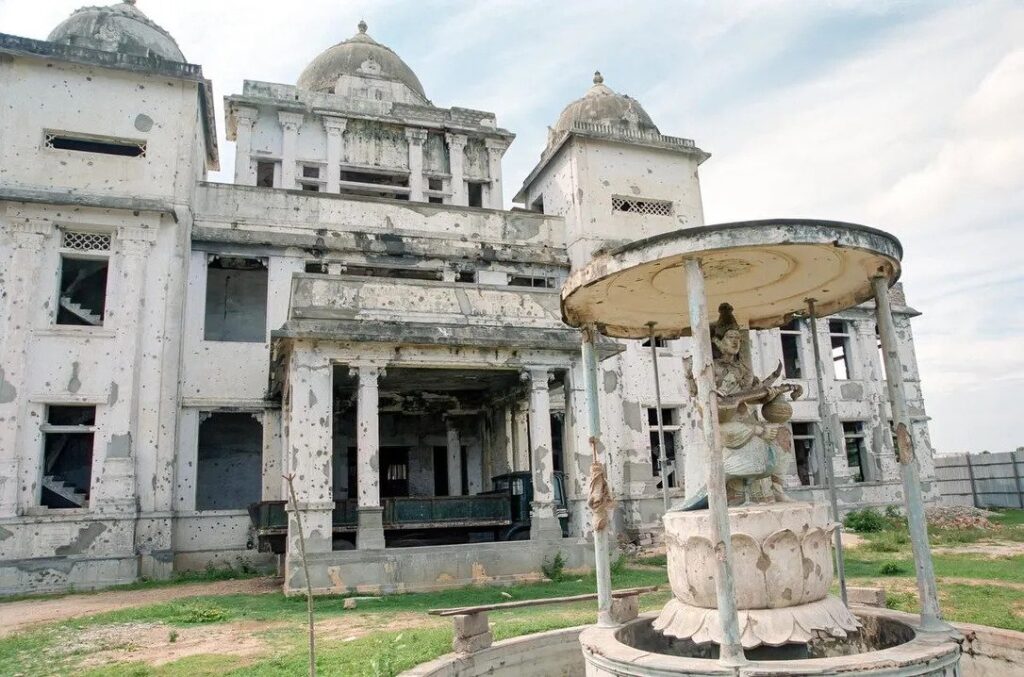
The consequences of this communal trajectory were not mythological. They were spelled out in state policy over subsequent decades: the 1948 disenfranchisement of Tamil plantation workers; the 1956 Official Language Act; the systematic discrimination against Tamils in university admissions, public service, and economic life; the anti-Tamil pogroms of 1958, 1977, 1981, and the catastrophic 1983 “Black July” in which hundreds of Tamils were killed by state-organized mobs; the burning of the Jaffna Public Library in 1981, destroying irreplaceable Tamil manuscripts — a cultural act of devastation whose parallel with the Taliban’s destruction of the Bamiyan Buddhas was noted by the WSWS, with the observation that Sri Lankan political and Buddhist hierarchical reactions were “mixed with a good deal of rank hypocrisy.” Each of these acts was accompanied by ideological justification drawn from the Mahavamsa’s narrative of Sinhala Buddhist civilizational priority and existential threat from “Tamil invaders.” The state built on the Mahavamsa’s narrative of eternal civilizational siege — amplified by the weaponized memory of Kalinga Magha — reached its logical terminus in mass killing and permanent military occupation of the north and east, the archaeological and cultural erasure of Tamil heritage in the north, and the accelerated Sinhala colonization of territories with centuries of Tamil habitation and cultural development.
The Mahavamsa did not cause this catastrophe, nor did the Kalinga invasion of 1215. The correct political conclusion from all of this history is not that the Mahavamsa is factually wrong about ancient invasions, that the Kalinga Magha invasion did not happen, or that the suffering inflicted on the Sinhala Buddhist civilization of the northern dry zone in the 13th century was not real. The Sinhala Buddhist civilization of Anuradhapura and Polonnaruwa was genuinely great — and it was also genuinely interpenetrated with Tamil, South Indian, and pan-Buddhist cultural currents that the supremacist reading must airbrush out of existence. None of this — however real and however terrible — provides any political or legal or moral basis for the present subjugation, discrimination, dispossession, or mass killing of Tamil people who have inhabited the north and east of Sri Lanka for centuries of documented, continuous, and deeply rooted civilizational life. The class interests of the Ceylonese / Sri Lankan bourgeoisie, serving international capital, wielding Sinhala Buddhist communal ideology as an instrument against working-class unity, caused the present catastrophe. What the ruling class of Sri Lanka has done is seize upon the genuine complexity and genuine suffering of the island’s ancient history and weaponize it in the service of a thoroughly modern project: the construction of a communal state that divides the working class, legitimizes the exploitation of both Sinhala and Tamil workers by the same capitalist class, and perpetuates a fratricidal war whose only beneficiaries are the ruling elites on both sides of the ethnic divide. The ancient chronicles were its chosen costume.
Today, the ICFI’s perspective — the United Socialist States of Sri Lanka and Eelam, unifying Sinhala and Tamil workers against their common class enemy — remains the only politically coherent answer to the Tamil National question. It is not an answer that springs from ignoring history, but from understanding it: understanding that the working class of Sri Lanka, across all the ethnic lines drawn by its rulers, shares a common class interest that is more powerful than any ancient chronicle, and that the realization of that interest is the only path out of a tragedy that ancient myths did not create and ancient myths cannot resolve.
The Deadly Anachronism: The Nation Projected Backward, the Past Conscripted to Murder the Present
Every ethnonationalism examined in this essay — Sinhala Buddhist supremacism, Tamil separatism, Hindutva, Zionism — rests on a common act of historical falsification. Before a temple is demolished, before a language is banned, before a militia kills in the name of ancient right, modern national identity is projected backward through time. The claim is made that “the Sinhalese,” “the Tamils,” “the Hindus,” “the Jewish people” have existed as cohesive, politically self-conscious nations across millennia, so that contemporary political claims acquire the appearance of immemorial, transhistorical right superseding the actual lives of actual populations in the present.
This is the deadly anachronism: the imposition of a historically specific, relatively recent category — the modern nation — onto social formations organized on entirely different material foundations, in which “national identity” as modern politics understands it was literally inconceivable. It is deadly not metaphorically but concretely: this anachronism has triggered pogroms, civil wars, and genocide against people whose actual crime is existing in the present.
The Marxist materialist tradition supplies the tools to demolish it. The modern nation is not eternal; it is a historically specific product of capitalism, forged through bourgeois revolutions that overthrew feudalism, established formal legal equality, created national markets, and standardized language through state institutions [10]. None of these preconditions existed in pre-modern Sri Lanka. The ancient hydraulic state organized social life through caste, monastic landownership, and tributary obligation, not through horizontal national citizenship. A peasant in an Anuradhapura village could no more have conceived of themselves as part of a unified “Sinhalese nation” than a medieval English villein could have conceived of modern English nationhood. Their social world was bounded by village, caste, and the immediate apparatus of revenue extraction. Language was not yet national identity; Old Sinhala was no more the vehicle of a continuous “Sinhalese nation” than Anglo-Saxon was of modern Englishness.
This is confirmed by the Mahavamsa’s own content. The chronicle’s boundaries between “Sinhala” and “Tamil” were political and dynastic, not ethnic in the modern racial sense: a South Indian king who patronized Buddhism could be absorbed into the island’s political culture, while a Sinhala king who failed the Sangha was condemned regardless of ethnicity. The categories were religious and customary, not national.
This is precisely why the Kalinga Magha invasion of 1215 functions so effectively as supremacist ideology despite being, on close examination, nothing of the sort. Magha was not Tamil; his mercenary army was multiethnic, drawn from across the subcontinent. To brand his conquest a “Tamil invasion” is to retroactively impose/project twentieth-century ethnic categories onto a thirteenth-century political event that did not operate by them. And even granting the chronicle’s account of devastation and southward migration in full, this establishes nothing about the present: the Tamil communities that subsequently built the Jaffna kingdom, its literature, and its agricultural civilization over the following eight centuries possess rights grounded in that continuous, documented habitation — not in whatever happened, or did not happen, in 1215.
One should ask the following questions to delve in further: Did a racial identity of “Sinhalese” actually exist in ancient Sri Lanka? Was this identity recognized across all strata of the social hierarchy? And could a low-caste peasant or an “untouchable” laborer in the feudal Anuradhapura system identify themselves as part of a unified “Sinhalese” racial community alongside the king, the Buddhist monk, and the landowning aristocrat? The answer to all three questions, from the standpoint of historical materialism, is an unequivocal and demonstrable no. What Sihala actually designated in the ancient chronicles was primarily a dynastic-linguistic-religious complex rooted in the legitimation needs of the monarchy and the Buddhist Sangha — not a biologically or even culturally homogeneous population understood to possess a common heritable destiny across all social strata. Examining why this is so takes us to the very foundations of the ideological fraud of modern ethnonationalism, revealing its class function with clinical precision. These issues demand separate and complete treatment, beyond the space of this essay.
The same anachronism operates with identical structure, and identical falsity, in Tamil nationalism. The LTTE’s claim to an eternal “traditional Tamil homeland” mirrors the Sinhala supremacist claim it opposes — both require projecting modern ethnic-territorial categories onto a past that did not contain them. As the ICFI has insisted, the demand for Tamil Eelam did not arise from some immemorial national consciousness finally awakening [11]; it arose from the betrayal of socialist internationalism by the LSSP, leaving Tamil workers to the mercy of Sinhala chauvinism and channeling justified grievance into a bourgeois separatist project serving the Tamil capitalist class, not the Tamil worker.
The grammar is identical across every case examined: an ethnic or religious category is first essentialized as unchanging across history; this essence is then extended backward and forward through time, collapsing the real discontinuities produced by changing modes of production; it is then anchored to a territory as an eternal homeland; and finally, any population currently inhabiting that territory outside the dominant category is delegitimized as intruder or invader, however long their actual residence. Marxism answers each step: human beings are constituted by historically specific social relations, not immutable essence; the ancient and modern bearers of an ethnic label are not the same people; no ancient claim overrides the rights of the living; and the population targeted for displacement is a present community possessing full contemporary rights.
The class function is decisive. The Mahavamsa was not weaponized by Sinhala peasants but by the Ceylonese bourgeoisie, above all Bandaranaike, to defeat the threat posed by Sinhala-Tamil working-class unity demonstrated in the 1953 hartal. As Trotsky’s theory of Permanent Revolution anticipated, the bourgeoisie of belated capitalist development, incapable of delivering genuine democratic transformation, substitutes communal mystification — ancient chronicles, eternal homelands — for the program it cannot fulfill.
The answer is not a counter-anachronism, asserting Tamil priority to match Sinhala priority. It is class analysis: the worker in a Colombo factory, the Tamil plantation laborer, the Jaffna fisherman share a present social reality of exploitation that no ancient chronicle can illuminate and no mythology can resolve. The ancient Sinhalese are not the modern Sinhalese; the ancient Tamils are not the modern Tamils. To identify an ancient identity with a modern identity is a fiction—a dangerous anachronism that serves the present bourgeois class interests. What unites the working people of the island today is not blood inherited from a thousand years ago but the shared necessity of overthrowing the capitalist state that manufactures their division — the perspective embodied in the fight of ICFI and SLLA for the United Socialist States of Sri Lanka and Eelam.
The Westphalian system, the right of self-determination and other principles
The invocation of ancient mythology and pre-modern history to deny the rights of a living community of people constitutes a reactionary abuse of history and an affront to well-founded political, philosophical and legal principles.
The post-1648 and post-1945 international imperialist order does rest on the principle of the inviolability of borders and the illegitimacy of conquest as a title to territory — which is precisely why it is reactionary and legally absurd to argue that a mythological event from three thousand years ago or a medieval conquest constitutes a present-day territorial claim. The populations of the present have rights derived from their present existence, not from their ancestors’ movements over millennia.
However, from a Marxist standpoint, we must go further than the Westphalian framework. The system of nation-states itself is a product of the bourgeois epoch, and in the imperialist period it has become a structure for the division of the world working class along national lines, for the subordination of smaller nations to great powers, and for the containment of socialist revolution within national borders. The ultimate answer to communal chauvinism is not the liberal nation-state — which can always be captured by communalists, as India demonstrates — but the international unity of the working class across all the lines that bourgeois ideology draws between them.
All peoples have the right of self-determination—the right of a population to determine its own political existence, to choose its own governance, and to exercise sovereignty over the territory it inhabits. This principle has both a bourgeois-democratic and a Marxist dimension. This right attaches to the people presently inhabiting and constituting the political community of a given territory — not to an ethnic, religious, or genealogical group claiming descent from ancient inhabitants. The right is grounded in present, actual, social existence. [12] A population that lives on a territory, builds its social life there, has its families and institutions and culture rooted there, is a “people” in the operative sense — and that status cannot be dissolved by a rival claim based on texts written thousands of years ago.
The principle of effective occupation (occupatio) is the basis for territorial sovereignty in cases where other grounds are disputed. The doctrine holds that sovereignty is acquired and maintained through actual, continuous, and peaceful administration of a territory, while a military occupying power does not acquire sovereignty over the territory it occupies.
The principle of jus sanguinis (right of blood descent — the principle that one’s ancestry determines one’s nationality) — cannot be applied to create an entitlement for an alien community to physically displace the people who have the right of the soil
(jus soli — the principle that one’s actual habitation, actual birth on the land determines one’s nationality).
Bourgeois international law correctly identifies the principles — self-determination, prohibition of territorial conquest by force, the illegality of genocide, the rights of present populations — but it has no mechanism of enforcement that operates independently of the great-power balance.
The Class Alternative
The fundamental point is this: the invocation of ancient myth and pre-modern history to justify present dispossession, discrimination, or ethnic hierarchy serves a ruling-class function. The Hebrew Bible is not the cause of the genocide. It is the ideological cover for a project whose real motor forces are material and geopolitical.
The biblical mythology of the Promised Land serves this imperial project in precisely the same way that the Mahavamsa served the Sinhalese ruling class and Hindutva serves the Indian bourgeoisie: it provides a transcendent, quasi-sacred justification for arrangements that are, in their actual content, the product of class interest, colonial history, and great-power geopolitics. The Israeli ruling class does not wage genocide against Palestinians because it is driven by sincere religious conviction, any more than Modi demolished the Babri Masjid because he genuinely believed Ram was born on that precise spot. The ideology is functional. It mobilizes a population, suppresses internal class opposition, and legitimizes externally what would otherwise be recognized as — and is recognized internationally as — a crime against humanity.
The ancient myth or pre-modern history is a weapon of the bourgeoisie against the working class — not a survival instinct of oppressed peoples. Hindu workers in Gujarat and Muslim workers in Dhaka share more materially with each other than either shares with Modi or the Bangladeshi garment factory owner. Sinhalese and Tamil plantation workers on the same estates were repeatedly united in strikes before the communalists — backed by the bourgeoisie — broke that unity. The myths of the Mahavamsa and the Ramayana are deployed precisely to shatter that unity and to ensure that exploited workers look sideways at the neighbor of a different religion or ethnicity—“Othering” process— rather than upward at the class that exploits them both.
The working class of the subcontinent — Indian, Sri Lankan, Pakistani, Bangladeshi — faces the same enemy: the domestic ruling class operating within the framework of global capitalism. The answer to Hindutva, Sinhala Buddhist supremacism, Pakistani religious nationalism, and all other forms of communalism is not a counter-mythology, not a rival ancient claim, but the political organization of the working class on a socialist and internationalist program.
We must be based on the principle that the ancient heritage belongs to all of humanity, not to a single community that may be misled to identify with it, that no ethnic group can appropriate it as a title deed of present-day dominion, and that living populations have rights based on their present existence. This principle must be defended. It must be defended not in the abstract liberal terms of “tolerance” or “pluralism,” which have proved utterly impotent before the fascist onslaught of the BJP and the Rajapakse and his successor regimes. It must be defended on the basis of working-class solidarity, socialist politics, and the fight to overthrow the bourgeois states that manufacture and deploy communal mythology as a weapon of class rule.
[3] Modi inaugurates a Hindu supremacist temple on the site of the razed Babri Masjid: One historic crime atop another, Wasantha Rupasinghe, Keith Jones, 21 January 2024 <https://www.wsws.org/en/articles/2024/01/22/zmxv-j22.html>
[4] Facing an international outcry, India’s Hindu supremacist government cynically distances itself from top BJP officials’ anti-Muslim incitement, Wasantha Rupasinghe and Keith Jones, 12 June 2022 <https://www.wsws.org/en/articles/2022/06/13/cmew-j13.html>
[8] Mario Kessler’s Socialists against Antisemitism and Leon Trotsky on Antisemitism: The Marxist movement and the fight against antisemitism and Zionism, Clara Weiss, 2 July 2025 <https://www.wsws.org/en/articles/2025/07/03/ajbz-j03.html>
[10] History in the service of ideology—Review of The Construction of Nationhood: Ethnicity, Religion and Nationalism, by Adrian Hastings, Ann Talbot, 30 April 1999 <https://www.wsws.org/en/articles/1999/04/hist-a30.html>
[12] Marxism does not simply endorse the bourgeois principle of self-determination at face value. Lenin’s treatment of the national question — the most sophisticated Marxist analysis of it — insists on the conditional character of the support socialists give to the right of self-determination. The working class supports the democratic right of oppressed nations to self-determination not as an absolute metaphysical principle, but as a concrete democratic demand in the struggle against national oppression, which itself is a product of imperialism and capitalism. Lenin’s conditional approach means that support for self-determination is always subordinated to the question: does this serve the international unity of the working class and the struggle against capitalism? The point is always to end oppression, not to create new nationalist frameworks that will themselves become instruments of class exploitation. The Palestinian right to self-determination is not supported by Marxists because of some absolute national principle, but because the Palestinian people are a colonized, brutally oppressed people whose democratic rights — to live on their land, to govern themselves, to be free from mass murder — are being systematically violated by an imperialist settler-colonial project. Supporting those democratic rights is a condition of the internationalist unity of the working class.
Statement by the Socialist Lead of Sri Lanka and South Asia (SLLA)
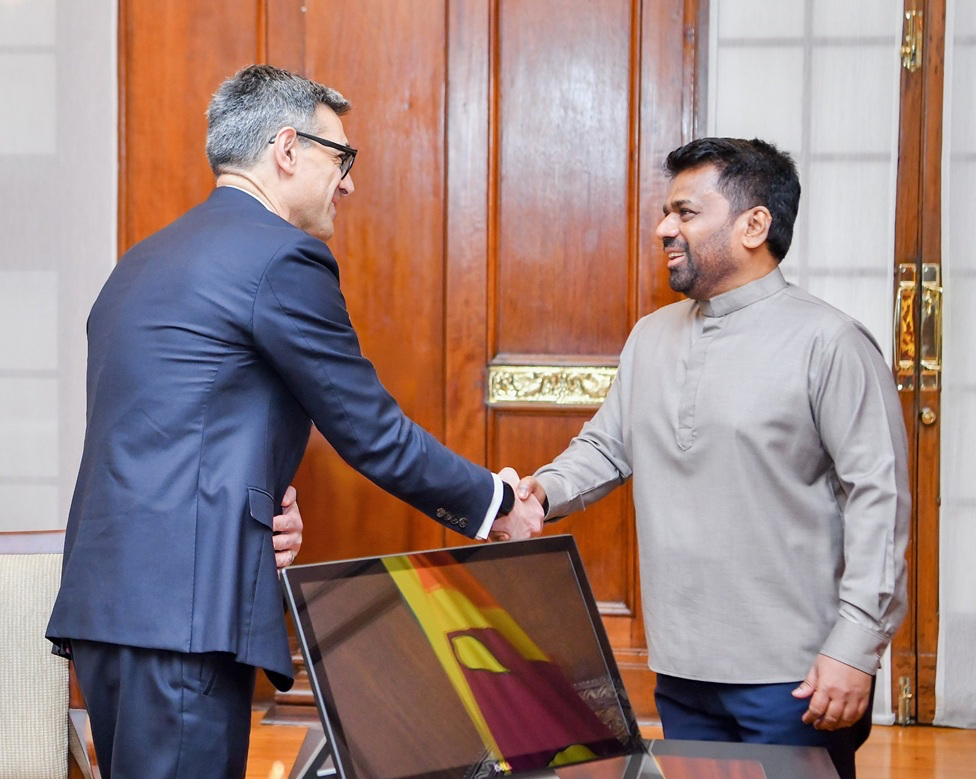
President Anura Kumara Dissanayake meeting with a visiting IMF delegation at the Presidential Secretariat on April 2, 2026. Image courtesy of midpoint.lk.
On June 5, 2026, the Janatha Vimukthi Peramuna (JVP)/National People’s Power (NPP) government of President Anura Kumara Dissanayake published a special gazette notification for a bill to establish the “Chartered Institute of Media Professionals of Sri Lanka (CIMP).” Tabled by the Ministry of Health and Mass Media, the bill is packaged in the soothing language of “introducing and maintaining professional standards” and “elevating quality.” This is a calculated fraud. A close examination of the bill’s provisions — its definitions, its institutional architecture, its disciplinary mechanisms — reveals an instrument of state censorship designed to discipline, silence, and ultimately eliminate independent journalism, above all the social media content creators and anti-government commentators whom the Dissanayake regime views as a mortal threat to its grip on power.
The working class and all defenders of democratic rights must reject this bill in its entirety. It is not a measure to improve journalism. It is a weapon for the suppression of democratic discourse, conceived in direct continuity with the long and bloody history of media repression in Sri Lanka, and fully consonant with the international offensive against press freedom being waged by capitalist governments across the globe.
The Architecture of State Control
The bill establishes a statutory body corporate — the Chartered Institute — whose design is transparently that of a state-controlled gatekeeper over who may legitimately practice journalism. Five features of the legislation expose its authoritarian character beyond any doubt.
First, the Institute introduces a system of state-created accreditation. Section 3(i) declares that one of the Institute’s objects is “to accredit the media professionals in media professionalism at the evaluation of their efficiency.” Section 4(o) empowers the Institute “to take necessary steps to introduce, develop, maintain and monitor professional standards.” Section 4(t) authorizes it “to maintain and publish a register of members.” Taken together, these provisions convert the fundamental democratic right of freedom of expression into a state-sanctioned privilege. The government positions itself as the ultimate arbiter of who may enroll, register, and be certified as a “qualified” media professional. Freedom of the press is an inherent right, not a license to be granted or revoked by the capitalist state. The very premise of the bill is an assault on this principle.
Second, the definition of “media professional” is deliberately vast and all-encompassing. Section 27 defines the term to include “writers, content developers, content editors, anchors, presenters, broadcasters, journalists, editors, publishers, media owners, media managers, media educators, media researchers, media technicians and camerapersons in the field of media.” The inclusion of “content developers” is particularly revealing. This wide net is cast with a specific purpose: to trap independent bloggers, social media commentators, and alternative left-wing media platforms under the disciplinary apparatus of the state. The Dissanayake administration is acutely threatened by unaligned online media. Mainstream corporate media networks in Sri Lanka are tightly controlled by oligarchs or the state itself. Working-class anger, exposures of government compliance with International Monetary Fund (IMF) austerity, and socialist political analysis find expression through alternative content creators and independent social media channels. By bringing “content developers” under the heel of a chartered state apparatus, the government is building a weapon to silence precisely these voices.
Third, the bill establishes a state-vetted Disciplinary Committee empowered to investigate “professional misconduct.” Section 12(1)(c) provides for the appointment of a Disciplinary Committee. Section 23(1) mandates that this committee “shall hold an inquiry whenever the Council refers any matter to the Disciplinary Committee in respect of a professional misconduct of a member.” Section 23(2) then defines “professional misconduct” as “an act or omission which shall be determined by rules of the Council made under section 26” — a definition so circular and elastic that it amounts to a blank cheque for the political punishment of journalists who refuse to toe the government’s line. Section 24 empowers the Council to “disenroll any member,” or in the alternative to “warn, reprimand or suspend him from membership for such period not exceeding one year.” The power to strip a media worker of professional credentials is the power to destroy a career — and to send a message of intimidation to every other journalist in the country.
Fourth, the bill creates an “Interim Council” appointed entirely by the state. Section 5(4)(a) provides that until the Governing Council is elected, the Minister shall appoint an Interim Council consisting of “the Secretary to the Ministry of the Minister” and “six other persons who have distinguished themselves with proven knowledge, eminence and at least twenty years’ experience in the field of media, nominated by the Secretary to the Ministry of the Minister.” This Interim Council is granted the power under Section 5(4)(b) to make rules “in respect of the number of members to be selected and the criteria to select such members to the Institute” and “to elect and appoint members and the office bearers to the Council.” The Interim Council thus controls who gets into the Institute in the first instance and who may sit on its permanent Governing Council. The entire institutional architecture — the membership criteria, the internal rules, the definition of what constitutes an offense — will be shaped entirely by political appointees of the capitalist state. The Institute will be, from its inception, an instrument of the government.
Fifth, the bill conspicuously lacks any explicit guarantee that membership in the Institute will never be a prerequisite to practice journalism. This omission is not accidental. It signals that the Institute is designed to become a mandatory gatekeeper. Unregistered or deregistered journalists could rapidly find themselves legally blocked from entering press conferences, obtaining state accreditation, accessing public events, or securing employment. The Institute is a mechanism for the de facto licensing of journalism — and therefore for the de facto banning of journalists the state finds inconvenient.
A Continuum of Repression
The CIMP Bill does not emerge from a vacuum. It is the latest in a long continuum of state attacks on press freedom in Sri Lanka, stretching back decades and across every bourgeois government.
The Press Council Act of No. 05 of 1973, introduced by the Sri Lanka Freedom Party-led coalition government — which included the Lanka Sama Samaja Party and the Stalinist Communist Party — established a government tribunal (Press Council) with the powers of a district court, empowered to conduct inquiries that could lead to imposition of fines and jail terms against journalists. Its chairman and members are appointed by the president. Among its targets was Kamkaru Mawtha, the newspaper of the Revolutionary Communist League — the forerunner of the Socialist Equality Party. Last September, the cabinet spokesperson announced that the cabinet has approved to amend the Press Council Act to expand its regulatory scope to encompass modern digital, electronic, and online media platforms. The historical irony is sharp: the JVP, whose own cadres were slaughtered by the thousands after the abortive 1971 uprising, today deploys the same mechanisms of press control pioneered by the regime that repressed them, now directed against the working class and its political representatives.
The Rajapakse regime (2005–2015) escalated media repression to police-state levels. In 2009, it revived the Press Council Act. In 2012, it moved to gag websites, extending the Press Council’s reach to online media. In 2013, it unveiled a “Code of Media Ethics” whose vaguely phrased clauses — banning publications that “offend against the expectations of the public” or “contain information which could mislead the public” — gave the government unlimited scope to suppress criticism. During this period, 16 journalists and media workers were killed by pro-government death squads, and Sunday Leader editor Lasantha Wickrematunge was murdered in broad daylight.
The Online Safety Act brought by the Ranil Wickremasinghe government in January 2024, purporting to counter “fake news”, attacked social media activism decisively. It dealt a major blow to freedom of expression by granting a government-appointed commission sweeping powers to police and censor online speech. Under the guise of preventing online harms, the law criminalizes legitimate dissent, investigative journalism, and social media criticism, threatening activists and content creators with severe prison sentences.
The JVP/NPP government is deepening this authoritarian inheritance, not breaking from it. In November 2024, within weeks of taking office, it announced it would not abolish the Prevention of Terrorism Act (PTA), despite having pledged to do so during the election campaign. Instead, it introduced a new “Protection of the State from Terrorism Act” (PSAT) that broadens the definition of terrorism to encompass strikes, protests, and dissent. In November 2025, following Cyclone Ditwah, Dissanayake declared a state of emergency and issued regulations making it a criminal offense — punishable by up to ten years’ imprisonment — to communicate or publish any supposedly “false” statements that could allegedly cause “public alarm.” Deputy Minister Sunil Watagala explicitly instructed police to treat social media critics “not merely as suspects but as offenders.” These powers were deployed to enforce deeper austerity under the guise of “rebuilding.” The state of emergency has now been extended six times,[1] giving Dissanayake sweeping dictatorial powers.
On May 28, 2026 — just one week before the Chartered Institute gazette — President Dissanayake issued a special gazette declaring the Government Press and State Media as essential services, effectively outlawing industrial strike action in those sectors. The Chartered Institute Bill is the ideological twin of this hardline measure. Together they form a pincer: the state attacks media workers’ right to withhold their labour, while simultaneously constructing a disciplinary apparatus to control what those workers may write and who may write at all.
The International Offensive Against Press Freedom
The Dissanayake government’s bill forms part of a global offensive by capitalist states to bring the press — and especially online media — under state and corporate control.
In December 2010, the Hungarian parliament under Prime Minister Viktor Orbán passed a comprehensive media law subordinating all public and private media to the control of a state “media council” composed of Orbán’s partisans. The council was empowered to impose fines of up to €730,000 for reporting deemed “politically unbalanced.” As the WSWS noted at the time [2], Orbán’s authoritarian course was not a “European oddity” but a preparation for “a new round of brutal social attacks” demanded by the international financial markets. The muzzling of the media and the bolstering of the state apparatus were undertaken in direct anticipation of the social conflicts that austerity would unleash.
Germany’s Network Enforcement Act (NetzDG), which came into force in 2018, created a legal framework for internet censorship under the pretext of combating “hate speech” and “fake news.” As the WSWS documented, [3] the law was “part of an international offensive to attack free speech online, aimed at suppressing left-wing and socialist views.”
In 2022, Britain’s Ofcom revoked the broadcast licenses of RT, couching the ban in the language of “impartiality” and “freedom.” In 2025, the European Union’s 17th sanctions package against Russia extended to banning pro-Russia and pro-Palestine media, representing what the WSWS called [4] “an open attack on the democratic right to freedom of the press.”
The pattern is unmistakable. Across the world, capitalist governments facing mounting social opposition are constructing legal and institutional mechanisms to police public discourse. The language is always the same: “professional standards,” “ethics,” “combating disinformation.” The purpose is always the same: to suppress working-class opposition and anti-capitalist analysis.
Austerity Requires Repression
The Chartered Institute Bill cannot be understood in isolation from the broader trajectory of the JVP/NPP government. Dissanayake came to power in September 2024 on a wave of popular discontent, posturing as an anti-establishment outsider. Within days of the new parliament convening, the government jettisoned its election pledge [5] to renegotiate the IMF bailout and committed itself to implementing the austerity program in full.
The record since then has been one of relentless attacks on the working class. The government has restructured and privatized state-owned enterprises, sharply increased fuel prices by approximately 40 percent since February 2026, raised electricity tariffs by 32 percent, hiked gas prices by 31 percent, and maintained strict spending limits even as a quarter of the population has fallen below the poverty line. In April 2026, an IMF delegation lavished praise [6] on Dissanayake, commending his “strict adherence to IMF dictates.” The president boasted that “Sri Lanka has met all targets set under the programme.”
The government now faces a deepening crisis [7]: a worsening balance of payments deficit, a sliding rupee, soaring oil import costs driven by the US-Israeli war on Iran, and simmering resistance from workers and the rural poor. It has responded with essential services orders, police violence against protesters, the arrest of student activists, the deployment of the military as strike-breakers, and the repeated extension of emergency rule. The Chartered Institute Bill is the latest escalation in this authoritarian trajectory — a preemptive strike against the dissemination of truth, against the journalism that exposes the real conditions of working people and provides the political analysis necessary for the working class to cohere into a unified revolutionary force.
The JVP: From Death Squads to “Professional Standards”
The JVP’s present role as the enforcer of media censorship must be understood in light of its political history. As the ICFI and WSWS have documented over decades [8], the JVP is not and has never been a socialist or workers’ party. It is a right-wing, nationalist, and communalist movement, steeped in Sinhala populism. In 1988–89, it carried out a campaign of assassinations in which hundreds of left-wing political opponents, trade unionists, and workers — including members of the Revolutionary Communist League — were killed. It was the most trenchant advocate of the racist war against the Tamil minority that culminated in the May 2009 massacre of 40,000 Tamils.
The JVP’s transformation into a party of bourgeois rule — implementing IMF austerity, deploying police-military repression, and now constructing a state apparatus for media censorship — is not a betrayal of its original principles. It is the logical culmination of its class character as a petty-bourgeois nationalist formation. The same party that once physically liquidated its left-wing opponents now seeks to silence them through the bureaucratic mechanisms of a “Chartered Institute.” The methods have been modernized; the objective — the suppression of working-class political independence — remains the same.
The Pseudo-Left and the Trade Unions: Enablers of Repression
The working class cannot look to the pseudo-left organizations or the trade union bureaucracy to defend democratic rights. The Frontline Socialist Party, which falsely postures as a left-wing opponent of the government, collaborates with the union apparatus, whitewashing its betrayals and channeling workers into dead-end negotiations and appeals to parliament. The trade unions affiliated with the JVP/NPP maintain a deathly silence and actively block all anti-government action by their members. Unions tied to opposition parliamentary parties — the Samagi Jana Balawegaya and the Sri Lanka Podujana Peramuna — call only limited actions aimed at defusing genuine working-class opposition.
None of these forces will mount a principled defense of press freedom, because all of them — government and opposition alike — support the IMF program that is immiserating the working class. All of them fear the independent political mobilization of workers and youth. All of them have an interest in controlling public discourse. The Chartered Institute of Media Professionals Bill is a bipartisan project in its essentials, just as the emergency regulations after Cyclone Ditwah were urged by opposition leader Sajith Premadasa before Dissanayake declared them.
Build the Independent Mobilization of the Working Class
The fight against the CIMP Bill is inseparable from the fight against IMF austerity, against imperialist war, and for the political independence of the working class. Freedom of the press is not a bourgeois luxury to be set aside until “economic demands” are won. It is a vital weapon in the class struggle. The working class needs unfettered access to information, analysis, and political debate — including and especially the revolutionary Marxist perspective advanced by the ICFI, the World Socialist Web Site andthesocialist.lk — to arm itself for the battles ahead.
The SLLA calls on workers, youth, journalists, online content creators, and all defenders of democratic rights to:
Reject the Chartered Institute of Media Professionals Bill in its entirety! This is not a bill to be amended — it is a bill to be defeated!
No to state licensing of journalists! Freedom of the press is a right, not a privilege granted by the capitalist state!
Defend the right of social media content creators and online commentators to publish without state interference!
Abolish the Press Council Act, the Prevention of Terrorism Act, the proposed Protection of the State from Terrorism Bill, and all repressive legislation inherited from previous regimes!
No to the essential services ban on Government Press and State Media workers! Defend the right to strike!
For the building of independent action committees across all workplaces to fight IMF austerity and the assault on democratic rights!
For the unity of Sri Lankan workers with their brothers and sisters in South Asia and internationally against the common enemy — global capitalism and its state institutions!
For a workers’ government based on workers’ committees, not the capitalist parties and their trade union appendages!
For the socialist reorganization of society — the only foundation for genuine democracy and press freedom!
The Dissanayake government is constructing the architecture of a police state because it knows that the social crisis it is deepening through IMF austerity will generate mass opposition. The working class must answer by constructing its own independent organizations — action committees in every workplace and neighborhood, democratically controlled and politically armed with a socialist-internationalist program. The fight against media censorship is a fight for the political independence of the working class. It is a fight that can only be won through the building of a revolutionary party and the mobilization of the international working class against the capitalist system in its entirety.
We, the Socialist Lead of Sri Lanka and South Asia, wage this fight in solidarity with the international programme of the International Committee of the Fourth International. We urge workers, youth, intellectuals and all defenders of democratic rights to join us in advancing this struggle and building the revolutionary leadership necessary for the fight for socialism.
By Sanjaya Jayasekera, Member, The Socialist Lead of Sri Lanka and South Asia (SLLA), the Revolutionary Left Faction of the Socialist Equality Party (SEP) of Sri Lanka. SEP is the Sri Lankan section of the International Committee of the Fourth International (ICFI), which publishes the World Socialist Web Site (WSWS).
Sangeethsan (Sangeethsan Facebook page)
On a day (June 2) that should have passed unremarkably in Kilinochchi, the Jaffna District Crime Detective Bureau, acting through Chavakacheri police, arrested a 24-year-old musician. His name is Ganesh Kumar Sankeethan (Sangeethsan) — known by his stage name “HipHop Sangee” (YouTube Channel name) — and his crime, according to the state, was uploading songs that the police allege indirectly glorify the separatist Liberation Tigers of Tamil Eelam (LTTE). He was remanded for two weeks under Section 3(h) of the Prevention of Terrorism Act (PTA), his lawyer K. Sayanthan verified.
Sangeethsan, a rapper, has earned widespread recognition within the local Tamil hip-hop community for compositions that combine social commentary with cultural storytelling. Many of his works are available through his social media accounts. Before we go any further, let us consider what one of those songs contains. It is not vague cultural expression or ambiguous artistic metaphor. It invokes அண்ணன் — Elder Brother — the term used in Eelam Tamil political culture to refer to Velupillai Prabhakaran. It speaks of the Tiger flag arriving in triumph. It honors the மாவீரன் — the Great Heroes, the fallen LTTE cadres — by name and by the imagery of their sacrifice. It calls on them to return and build the nation. It invokes கார்த்திகை — November — the month of Maaveerar Naal, the annual mourning of the LTTE dead, as its emotional and symbolic landscape: flowers are brought to the fallen, their weeping families cry out to them, and the dead are called back to build the nation.
These are the lyrics of a young man from a war-ravaged district who grew up surrounded by grief, who found in music a way to articulate what his community has been undemocratically forbidden to say openly since May 2009.
We state these facts not to hand ammunition to those who want Sangeethsan kept in a cell. We state them because this article is committed to a principle that the Sri Lankan state and its chauvinist supporters on social media are equally committed to destroying: that honest politics must begin with the truth, not with convenient omissions. The question before us is not whether Sangeethsan’s lyrics express a political program we endorse. They do not — and we will explain why, plainly and without condescension, in the paragraphs that follow. The question before us is a different and more fundamental one: does any democratic society have the right to imprison a 24-year-old for the political content of his songs?
The answer is no. Unequivocally, no.
Freedom of political expression — including the freedom to express a politics that is wrong, mistaken, or even one that others find deeply objectionable — is a right that the working class defends with the greatest vigilance, with one principled and non-negotiable exception: fascist speech and fascist organization. We defend such expressions not because all political ideas are equally correct, but because the repressive legal machinery constructed to silence Tamil grief today is the same machinery that will be turned on striking workers, protesting students, and anyone else who challenges the authority of the capitalist state tomorrow. This is not a theoretical warning. It is the documented history of the PTA, other security laws and essential services laws in Sri Lanka, which have been used against Sinhala rural youth, students, Muslim youth, Tamil journalists, plantation workers, electricity workers and port workers with equal and indiscriminate brutality.
This article is not written primarily for those for whom what we discuss here is their daily experience. It is written for Sinhala youth, for middle-class families in Colombo and Kandy and Galle, for workers on plantations and in factories, who have been told their entire lives that the Tamil question was settled in May 2009, that “terrorism” was defeated, and that any sympathy for Tamil political expression is a conspiracy against the nation. It is written for those who, upon seeing Sangeethsan’s lyrics circulated on social media, may have felt the trained reflex: Tiger flag, Prabhakaran, Tamil Eelam — this is exactly what the PTA is for.
It is written to ask: who taught you to feel that reflex? Who benefits from it? And what has it cost you — not as a Sinhala person, but as a worker, as a young person, as someone whose living standards are being destroyed by the same state that is filling its remand prisons with Tamil youth and artists?
A Ban Designed Not to Fight Terror, But to Manufacture It
The formal proscription of the LTTE has been maintained continuously since the government of Mahinda Rajapakse banned it by gazette in January 2009, just months before the military’s final offensive ended the civil war. A final gazette in 2011 consolidated and extended this proscription to cover “related activities.” Every government since — Sirisena’s, Wickremesinghe’s, Gotabaya’s, and now Dissanayake’s JVP/NPP government — has maintained this framework intact.
When the Socialist Equality Party (SEP) opposed the original 2009 ban, it explained with precision what the ban was actually for. The statement issued at the time noted that the ban “has no direct bearing on the LTTE — the government is already waging war against the Tamil separatist organisation.” It warned that the decree’s sweeping powers to proscribe organisations “connected with or representing” the LTTE could “immediately be used against the Tamil National Alliance, a parliamentary political party.” And it predicted, with complete accuracy, that “such broad definitions, however, could be applied to any organisations, including political parties, trade unions or student bodies, that are regarded as opponents of the government.”[1]
Seventeen years later, those warnings have been borne out in case after case. The PTA has been used to imprison Tamil detainees for years without trial, to torture a young Muslim poet named Ahnaf Jazeem for writing verse that condemned ISIS and imperialist war, and to harass Tamil journalists. The JVP/NPP government — elected on a promise to abolish the PTA — has already used the Act against Muslim youth who expressed opposition to the Gaza genocide. In August 2025, the Counter Terrorism and Investigation Division (TID) questioned a Tamil journalist who reported on mass graves in the North. The new Protection of the State from Terrorism Act (PSTA) being drafted to replace the PTA reproduces its essential features while expanding the scope of what can be defined as a “terrorist act” to include actions that “intimidate the public” or “compel the government to do or abstain from doing any act” — language that could criminalize strikes, protests, and any form of organized resistance.
The instrument changes. The purpose remains identical: to place in the hands of the capitalist state an infinitely elastic legal weapon that can be pointed at anyone, at any time.
The Criminalization of Memory is Not an Accident
To understand why a 24-year-old rapper from Kilinochchi sits in a remand prison for singing about Tamil Eelam, you have to understand what kind of region Kilinochchi is, and what kind of wound the state is insisting must never be named.
Kilinochchi was the administrative capital of LTTE-controlled territory. It was also the site of some of the most intense fighting and civilian displacement in the final years of the war. The surrounding region of the Vanni was the theater of the last stages of a conflict in which, according to United Nations estimates, tens of thousands of Tamil civilians were killed. The survivors of that catastrophe — the families who lost fathers, mothers, husbands and children, who spent months in detention camps, who rebuilt lives from rubble — now live in a society where any public expression of that experience can be treated as a criminal act.
Sangeethsan is not a terrorist. He is a young man who grew up in the aftermath of that catastrophe, processing it in the only way artists know how: through music. To understand what is really at stake — politically and morally — we must read what he actually sang, and then ask not whether we agree with every word, but whether any democratic society can justify locking a young person in a remand cell for singing them.
This is not incidental to the logic of the PTA. It is the logic of the PTA. The state knows perfectly well that a military revival of the LTTE is structurally impossible and virtually non-existent. There is no evidence of serious LTTE organizational infrastructure, no military command, no armed force in the field. The proscription is maintained not because the LTTE poses a threat, but because the legal apparatus of the proscription remains extraordinarily useful — for precisely this: to convert political grievance into criminality, to transform memory into evidence, and to force the Tamil population into a permanent condition of political silence under pain of imprisonment.
This is what the SEP observed in August 2022, when the Wickremesinghe government, in the very same extraordinary gazette in which it delisted some Tamil diaspora groups for diplomatic purposes, continued to maintain the proscription framework: “The continued proscription of Tamil and Muslim groups is part of ongoing efforts by one government after another to whip up Sinhala chauvinism and discrimination against the country’s oppressed minorities. Facing the mass opposition of workers and the poor, the crisis-ridden Wickremesinghe regime is determined to keep communal tensions alive and deepen the repressive measures.” [2]
The pattern is consistent across every government of the post-independence era. The names change — UNP, SLFP, PA, UPFA, SLPP, JVP/NPP. The policy does not. This is not an accident. This is the function that communalism has always served in Sri Lanka: as the SEP noted in its analysis of 60 years of post-independence history, “Six decades of independence have brought ordinary working people nothing but communal conflict, deepening social misery and increasingly anti-democratic methods of rule.” The beneficiaries of that dynamic have never been ordinary Sinhala working people. They have been the ruling class, which has used ethnic division to rule a fractured country and impose economic policies that serve capital at the expense of all working people, regardless of their ethnicity.[3]
Read the Lyrics — Then Ask the Right Question
Let us be honest about what Sangeethsan sang in the song that we referred to above. His lyrics are not ambiguous cultural nostalgia. They invoke அண்ணன் — Elder Brother — a term that in the context of Eelam Tamil political culture refers unambiguously to Velupillai Prabhakaran. They speak of a Tiger flag arriving in triumph. They use the term மாவீரன் (Maaveeran) — Great Hero — the specific honorific reserved for fallen LTTE cadres. They invoke the month of கார்த்திகை (Karthikai/November), which is the month of Maaveerar Naal, the annual commemoration of the LTTE’s dead. They call upon the heroes to “come back” and “build the nation.” They speak of warriors whose “sulfur-scented bodies blended into the wind” — the gunpowder of the battlefield rendered as the smell of sacrifice. This is explicitly a song of mourning for, and celebration of, the LTTE’s slain fighters and their leader. The lyrics read, in part:
The Tiger flag of our Elder Brother is arriving, make way and clear the path!
Tamil Eelam dances in roaring triumph, his name echoes in every direction!
O great heroes who died protecting the soil, time shall never forget you!
Come back, come back, please come back again, to display your bravery and to build the nation! [most approximate English Translation]
These sentiments, as expressed, justify no arrest. We understand the content of it because any serious political analysis must begin with reality. But we unequivocally say that the 24-year-old youth from Kilinochchi should not be imprisoned for writing and singing this song.
Sangeethsan’s song is not fascist speech. The working class does not defend fascist speech — it demands the prosecution of fascist outfits and their financial backers. This distinction is not arbitrary. It is rooted in the nature of fascism itself: unlike any other political tendency, however wrong, fascism does not seek to win political argument — it seeks to annihilate the very conditions under which political argument is possible. Sangeethsan’s song is the very expression of a grief-stricken and oppressed people rendered in music. But this legal machinery, constructed to silence Tamil grief and working-class resistance, is never — without a single exception in the entire post-independence history of Sri Lanka — the machinery turned against the Sinhala chauvinist and communalist outfits that the ruling class courts, funds, and shelters precisely when the class struggle sharpens. The Bodu Bala Sena’s incitement of anti-Muslim pogroms, the Sihala Urumaya’s ethnic provocations — none of these drew the ferocity of the PTA. The state does not point its anti-terror machinery at the forces of communalism. It points it at the forces of class struggle. That asymmetry is not incidental. It is the entire point.
To genuinely serve Tamil youth — and to speak honestly to Sinhala workers who need to understand what is happening — we must ask the harder question that state repression is designed to prevent anyone from asking: What does it mean that a generation of Tamil youth in Kilinochchi and Jaffna and Mullaithivu genuinely love Prabhakaran and genuinely mourn the LTTE’s dead?
It means something real and painful. As already said, these young people grew up in the rubble of a bloody war. They grew up in a region under continuous military occupation, where soldiers still control Tamil lands, where surveillance is a fact of daily life, where their elders were disappeared, where mass graves continue to be discovered. They grew up in districts where, even before the 2022 economic collapse, poverty levels in Mullaithivu district reached 40 percent. In this reality, Prabhakaran is not a political program to them. He is a symbol of the idea that someone, once, stood up and fought back.
The grief is real. The anger is legitimate. The desire for dignity is not only human — it is politically necessary. And the passion that Tamil youth pour into songs like Sangeethsan’s is the raw material of a generation searching desperately for something to believe in.
The question that our revolutionary movement poses is therefore not: “How do we suppress this passion?” The question is: “Why is this passion flowing into Tamil nationalism instead of socialist politics?” And the answer to that question leads us directly back to the Colombo ruling class — and to the specific responsibility of the Sinhala working class and its potential for genuine solidarity with Tamil workers and the poor. The state that criminalizes Sangeethsan’s song is not only persecuting Tamil youth. It is actively working to ensure that their passion never finds its correct political destination.
Who is being Deceived, and Why
Here we must speak directly to the Sinhala readers of this article — especially to young people who, when Sangeethsan’s arrest was discussed on social media, may have felt that instinctive reaction: he shouldn’t have been singing about Tamil Eelam, that’s LTTE territory, what did he expect?
That reaction is not yours. It was installed in you.
For decades, the Sri Lankan ruling class and its corporate media have conducted a systematic program of militarization of the society and political conditioning. Sinhala children grew up with a version of national history in which the Tamil struggle for democratic rights was, from its very origins, portrayed as a foreign conspiracy and a terrorist project. The legitimate grievances that produced the Tamil national movement — the systematic language discrimination of 1956, the anti-Tamil pogroms of 1958, 1977, and 1983, the deliberate exclusion of Tamils from state employment and university admissions — were erased from public consciousness. In their place was substituted a permanent security narrative of fear mongering: we are under threat, we must be vigilant, any sympathy for Tamil identity is sympathy for terrorism. War has been rationalized as necessary, and the military has been glorified as “war heroes” (Rana Viru), ready to be deployed against any struggle of the working class united across ethnic divisions.
This communalist project was never a natural outgrowth of Sinhala culture or Buddhism. It was a deliberate political construction, launched by the Sri Lanka Freedom Party in 1956 as an electoral strategy to outbid the conservative UNP, and then reproduced by every faction of the ruling class because it served a vital class function: it prevented the Sinhala and Tamil working class from recognizing their common interests and uniting against the system that exploited them both.
The result can be seen today on TikTok, Facebook, and X. The moment a Tamil artist, journalist, or ordinary citizen uses the vocabulary of their own history — “Tamil Eelam,” “homeland,” “genocide,” “accountability”, “war crimes”, “commemoration” — sections of Sinhala social media erupt in denunciation. These users do not consider themselves tools of the state. Many of them are themselves suffering from the same economic devastation — unemployment, inflation, the IMF’s austerity measures, collapsing public services — that Tamil workers in the North and East are suffering. They have been successfully redirected. The enemy they have been given is not the class that rules them, but the neighbor who speaks a different language and carries a different wound.
Here is the dialectic that the ruling class has maintained for seven decades, and which it is essential for Sinhala workers and youth to understand: Sinhala chauvinism produces Tamil nationalism, and Tamil nationalism, in turn, reinforces Sinhala chauvinism. Each tendency is the mirror image and the fuel of the other. When Colombo discriminated against Tamil language rights in 1956, it created the conditions for Tamil political mobilization. When that mobilization was met not with redress but with pogroms, it created the conditions for Tamil armed separatism. When Tamil separatism launched attacks on Sinhala civilians, it was used by the Sinhala ruling class to justify yet more state terror against Tamils — and to intimidate Sinhala workers who might otherwise have seen through the charade. And when the state now arrests a 24-year-old for singing about Prabhakaran or Tamil Eelam, it ensures that another generation of Tamil youth will conclude — understandably, though incorrectly — that there is no path forward except through Tamil nationalism.
The LTTE’s political program was the program of an aspiring Tamil bourgeoisie, not the Tamil working class. As the ICFI analysis of the LTTE’s defeat made clear, the LTTE was utterly incapable of making a political appeal to Sinhala workers precisely because its perspective was based on ethnic struggle rather than class struggle — and its denunciations of the entire Sinhala population for the crimes of the Colombo government ensured that the very working-class unity that could have changed everything was permanently foreclosed.[4] The LTTE’s violent attacks on ordinary Sinhalese civilians served the same reactionary purpose as the government’s Sinhala supremacism: to divide the working class along ethnic, religious and linguistic lines and thereby strengthen the hand of Sinhala chauvinist forces in Colombo. The LTTE’s military defeat in 2009 resolved nothing. It left the Tamil masses with their democratic rights still denied, their land still occupied, their poor still impoverished — and their youth still searching for a political direction.
That is the political vacuum into which songs like Sangeethsan’s speak. They should not be criminalized and suppressed. They should be answered — with a socialist program that offers Tamil workers what Prabhakaran could never offer: genuine unity with the Sinhala and Muslim working class in a common fight against the capitalist state that oppresses all of them.
The State that Imprisons Sangeethsan will come for You Next
This is the point that must be grasped most clearly by Sinhala workers and youth who might be tempted to view Sangeethsan’s arrest as a Tamil problem, not their problem.
The PTA was enacted in 1979 to suppress Tamil militant organizations. But, it was never only about Tamils. It was used to bloodily suppress the JVP uprisings of 1988–1990 — killing tens of thousands of oppressed Sinhala rural youth. It has been used against Sinhala journalists, trade unionists, and political opponents. And under the JVP/NPP government that came to power promising to abolish it, the PTA has been invoked against Muslim and Tamil youth and it has used the Essential Public Services Act against electricity workers who protested and postal workers who struck.
The logic is identical in every case: the same state apparatus that defines Tamil cultural expression as “terrorism” will define your strike, your protest, your social media post criticizing the IMF as “terrorism” whenever it becomes convenient. The elastic definitions being written into the new PSTA — acts that “intimidate the public” or “compel the government to abstain from doing any act” — are not aimed at a nonexistent LTTE or any other such outfit. They are aimed at the working class. All of it. Sinhala, Tamil, Muslim.
The infrastructure of surveillance and military occupation maintained in the North and East since 2009, nominally to prevent an LTTE revival, serves a second function that should be legible to any honest observer: it is a standing model and template for the kind of state control that the ruling class intends to extend southward as the social and economic crisis deepens. A state that has kept an entire population under military surveillance for seventeen years after the end of a war, that imprisons a 24-year-old musician for his song lyrics, is a state that has long since abandoned any pretense of democratic governance.
The Way Forward: Unity of the Working Class against the Capitalist State
Sangeethsan must be released immediately and unconditionally. The charges against him must be dropped. The PTA should be abolished, and its successor legislation, the PSTA — which is the same weapon with a new label — should not pass. The military occupation of the North and East must end. All political prisoners held under these laws must be freed.
These are not Tamil demands. They are the demands of the entire working class, because the democratic rights of any section of the working class are the democratic rights of all of it.
The Socialist Equality Party, in which we, the SLLA, represent a revolutionary tendency, has maintained this position without deviation since its founding as the Revolutionary Communist League, through the entire 26 years of the civil war and its aftermath. We opposed the communal war when the JVP was supporting it. We defended Tamil democratic rights when the trade union bureaucracies were silent. We campaigned for the release of Tamil detainees held without trial under the PTA when no other political party would. And we have always done so on the basis of a clear class analysis: not because we gave political support to the LTTE’s separatism — which program represented the interests of a section of the Tamil bourgeoisie, not Tamil workers and farmers — but because the defense of democratic rights is inseparable from the unity of the working class, and because Tamil workers and farmers could defend their own interests only by uniting with Sinhala working people in a common struggle against capitalism.
To Tamil youth who love these songs, who light candles in November and weep for the Maaveerar: your grief is not misplaced, and your passion for dignity is a political resource, not a pathology. But Prabhakaran’s program failed — not because he was betrayed by the international community or outgunned by the army, but because a separate Tamil capitalist state could only ever reproduce the poverty and exploitation that Tamil workers already endure, in a new flag’s colors. The answer to discrimination and communal oppression is not to be found in a separate state, but in the unification of the oppressed in a common struggle for socialist revolution. The state that murders Tamil aspirations with the PTA is the same state that destroys Sinhala workers’ living standards with IMF austerity. Your enemy is not the Sinhala worker in a factory in Colombo. Your enemy is the class that rules them both. The revolutionary tradition that actually fought for your rights — that opposed the communal war when the JVP was cheering it on, that campaigned for Tamil political prisoners when no other party would, that demanded the withdrawal of the military from the North and East — is the Trotskyist tradition of the Socialist Equality Party. That is the tradition worthy of your passion and your fight.
The arrest of Sangeethsan is not an isolated incident. It is the latest manifestation of a strategy that has defined Sri Lankan capitalism since independence: divide the oppressed along ethnic lines, criminalize the memory of the oppressed, and use the machinery of anti-terrorism law to suppress any movement that threatens the rule of capital. Every government has played this game. The JVP/NPP, which rode to power on the wave of the 2022 Aragalaya uprising with promises of democratic reform, is playing it now.
The answer to this strategy is not Tamil separatism, which has proven a dead end that cost hundreds of thousands of lives. Nor is it Sinhala Buddhist chauvinism, which has served as the ideological cover for every act of state terror. [5] The answer is the political unity of Sinhala, Tamil, and Muslim workers, organized independently of all factions of the capitalist class and all its parties, fighting for the common program of socialist internationalism that addresses the interests of all working people against the IMF’s austerity, against militarism, against the entire apparatus of communalist state repression. This unity demands an unconditional and outright refusal to be trapped by the communal divisions that the ruling class has imposed on all of us.
Free Sangeethsan Now! Abolish the PTA—No Replacement! Build the united socialist movement of the working class!
[5] Tamil separatism, however mistaken its program, arose as a response to systematic national oppression. Sinhala Buddhist chauvinism is the ideology of the oppressor nation’s ruling class — it is supremacist in its very foundations, asserting the primacy of Sinhala Buddhist identity over all other communities as a justification for state discrimination, pogroms, and military terror. “Chauvinism” is the Marxist term of art for aggressive, supremacist nationalism deployed in the service of a ruling class — named after Nicolas Chauvin, the symbol of blind, belligerent national superiority. It carries the correct political charge that “nationalism” does not, in relation to Sinhala Buddhist class hegemony.
By Sanjaya Jayasekera, Member, The Socialist Lead of Sri Lanka and South Asia (SLLA), the Revolutionary Left Faction of the Socialist Equality Party (SEP) of Sri Lanka.
Mawpiya Sevana Home engulfed in flames. Image courtesy of nagalandpost.com
On the evening of June 3, 2026, fire consumed the Mawpiya Sevana care facility in Batagoda, Anguruwatota, near Horana in the Kalutara District. Twelve residents — elderly men and women, people living with mental illness, people with intellectual disabilities — died. Eight more were severely injured. Seventy-one human beings were packed into a building designed for fifteen. The first instinct of the bourgeois press, the political establishment, and the state apparatus is to render this a story about regulatory failure: the home was unregistered, the owner has been arrested, the Defence Secretary visited the ruins. Officials speak of stricter enforcement, mandatory inspections, and compliance frameworks. A proprietor sits in remand custody. The machinery of bourgeois law performs its theatre of accountability.
We reject this framing entirely. The deaths at Mawpiya Sevana are not a regulatory scandal. They are a systemic indictment — the concentrated and visible expression of what capitalist society does to human beings who can no longer be profitably exploited.
The Fundamental Logic: Discarded Lives
To understand this tragedy scientifically, one must begin with the logic of capital itself. Under capitalism, the value of a human being — in the brutal calculus of the system — is indexed to their capacity to generate surplus value. The worker sells their labour power; capital extracts from that labour power more value than it returns in wages; the difference constitutes profit, the lifeblood of the system. This is the elementary truth established by Marx in Capital and confirmed by every hour of every working day across the planet.
What, then, of those who can no longer labour? What of the elderly, the severely disabled, those living with serious mental illness? In the language of capital, they are unproductive. They generate no surplus value. They are, from the standpoint of the system, a cost — a drain on resources that could otherwise be directed toward accumulation. Capitalism does not produce sentimentality toward those it cannot exploit. It produces neglect, abandonment, and, at the sharp end of underdevelopment, mass death.
This is the political truth behind the twelve corpses at Mawpiya Sevana. These were human beings whom the system had already written off. They had no social security worth the name. They had no public institutions capable of housing and caring for them with dignity. They were deposited — warehoused — in an overcrowded, unregistered private facility, in a building designed for fifteen, because their families, themselves workers ground down by decades of austerity, had no alternative. The capitalist state knew this was happening. It tolerated it, because the alternative — a publicly funded, adequately staffed, universally available system of elder care and disability support — would require precisely the kind of social expenditure that the ruling class and its international creditors have placed beyond political possibility.
The IMF and the Deliberate Dismantling of Social Provision
This brings us to the immediate political context, which is inseparable from the structural one. Sri Lanka is presently in the grip of one of the most savage austerity programs in its history, administered under the direct supervision of the International Monetary Fund. The 2022 foreign debt default and the social explosion that swept former President Gotabaya Rajapaksa from power opened the door to an IMF bailout — and with it, the full subordination of Sri Lankan economic and social policy to the demands of international finance capital.
Every government since — from Wickremesinghe to the present JVP/NPP administration of Anura Kumara Dissanayake — has functioned as a transmission belt for IMF dictates. The 2026 budget allocates a staggering 4.5 trillion rupees (450,000 crores Rupees. Approximately US $13 billion) for debt servicing alone — money extracted from the labour of Sri Lankan workers and the rural poor and transferred to international bondholders, banks, and multilateral creditors. To meet this obligation, the government has slashed public expenditure across every social domain: health, education, welfare.
The health system is collapsing under the pressure of these cuts. Public hospitals run out of essential medicines — insulin, antibiotics, cancer drugs, psychiatric medications. Patients wait over a year for MRI scans and die during the wait. Nurses are so overworked and under-resourced that they have no chairs to sit on. The government’s own health minister, confronted with the medicine shortage, told patients to “buy them from the cheapest places.” This is not negligence. This is deliberate policy, enforced under IMF conditionality and praised by international financial institutions as evidence of “fiscal discipline.”
Into this landscape of deliberate social destruction, the question of elder care and disability support does not even register as a policy priority. The JVP/NPP government moved in late 2025 to slash the Aswesuma welfare program — a meagre cash transfer scheme paying between 5,000 and 17,500 rupees per month (approximately US$16 to $57) to the disabled, the elderly, kidney patients, and the extreme poor. Even this minimal safety net is under attack, with the World Bank pressing for a reduction in the number of beneficiaries and a JVP minister publicly declaring that welfare recipients should “feel ashamed” — calling it “legal begging.” As the World Socialist Web Site (WSWS) has noted, this language carries chilling historical echoes: it frames the destitute not as victims of a system, but as parasites upon it.
It is in this context that Mawpiya Sevana existed. The state did not build, fund, or staff adequate public residential facilities for the elderly and the disabled — not because it lacked the administrative capacity to do so, but because the entire fiscal framework of Sri Lankan capitalism, as restructured by the IMF, prohibits such expenditure. The government allocates debt repayments nearly nine times the health budget. There are simply no resources directed toward the systematic, universal care of those who cannot work. In their place, a black market of unregistered, unregulated, overcrowded private facilities fills the vacuum — precisely because working-class and poor families, themselves crushed by falling real wages, rising prices, and the destruction of social services, cannot provide the full-time care that the state refuses to provide.
The State Knew, and the State Did Not Care
It would be politically dishonest to attribute what happened at Mawpiya Sevana to ignorance or inattention on the part of state authorities. The Director of the National Secretariat for Elders has confirmed that the facility was known to the authorities, that it was unregistered, and that it had previously been warned to comply with regulations. Officials knew. They did not act, not because the machinery of enforcement was insufficiently developed, but because the state had no institutional alternative to offer the residents. To shut down Mawpiya Sevana without providing a publicly funded substitute would have been to condemn seventy-one people to destitution or homelessness. The state permitted the facility’s continued operation because the alternative — genuine social provision — is structurally excluded by the political and economic priorities of the ruling class.
This is the functioning logic of the capitalist state in an underdeveloped country operating under IMF tutelage. It is not an aberration from the normal functioning of the system. It is the system functioning normally. The capitalist state in Sri Lanka — as in every neocolonial country — is not an instrument of social welfare. It is an instrument of capital accumulation, debt repayment, and the maintenance of the conditions necessary for the exploitation of labour. Those who cannot be exploited — the elderly, the severely disabled, those with serious mental illness — fall outside this framework entirely. They are residue. They are waste. The system does not know what to do with them except minimize the cost of their existence and, when they die in preventable fires, process the deaths through the criminal justice system to defuse political pressure.
The Feudal Supplement and Its Limits
In the absence of any meaningful social security system, the burden of care for the elderly and disabled in Sri Lanka — as throughout the countries of the periphery — falls on the feudal-cultural obligations of family and kinship networks. Sons and daughters are expected to provide, to sacrifice their own economic lives, to absorb the cost that the state refuses to bear. This system of informal social reproduction (provision of public goods — healthcare, education, social security — necessary to maintain a productive workforce) does not represent cultural high standards. It is a structural necessity for capital: it permits the ruling class to avoid the costs of social reproduction that workers in more developed capitalist countries extracted through generations of struggle — pension systems, public health systems, residential care facilities, disability support.
But this feudal supplement is itself being eroded by the same forces of capitalist development and austerity that make it necessary. As real wages collapse — down 24 percent in the public sector and 14 percent in the private sector since 2022, according to World Bank data — working-class families have fewer resources to provide informal care. Emigration, driven by economic desperation, separates families across continents. The nuclear family unit, under the pressure of capitalist commodity (property) relations and austerity, cannot substitute for the collective social infrastructure that only a socialist society can build and sustain.
The result is the proliferation of informal, unregistered, unregulated private facilities like Mawpiya Sevana — a catastrophic market response to a catastrophic social failure. People with nowhere to go, and nowhere else to put their relatives, are concentrated in buildings not designed to hold them, run by proprietors operating outside any regulatory framework, because the regulated, publicly funded alternative does not exist. The owner of Mawpiya Sevana now faces criminal charges. He may be guilty of negligence. But the system that created the conditions in which he operated — the IMF, the successive Colombo governments, the entire apparatus of neocolonial austerity — faces no charges at all.
The Question of Political Responsibility
The JVP/NPP government of Anura Kumara Dissanayake bears direct political responsibility for the conditions that produced this tragedy. This is a government that came to power presenting itself — fraudulently — as a movement of the working people, invoking the language of “people’s power” and social transformation. Its actual record is one of ruthless implementation of IMF directives, attacks on welfare recipients, the deployment of the military against striking postal workers, the invocation of Essential Services legislation to suppress workers opposing privatization, and the systematic underfunding of health and education.
But responsibility does not end with the current government. Every government that has administered Sri Lankan capitalism since independence — the SLFP, the UNP, the SLPP, and now the JVP/NPP — has presided over the gradual destruction of whatever social provision existed and its replacement with the “free market”: privatization, commercialization, the withdrawal of the state from any domain of social reproduction that cannot generate profit for capital. The entire political establishment is complicit. The opposition parties — the SJB, the SLPP, the UNP — offer only “token criticisms” while accepting the IMF framework in its entirety.
The trade union bureaucracies, which claim to represent the interests of working people, are equally implicated. They have systematically suppressed independent workers’ action, called off strikes on the basis of empty promises, and functioned as transmission belts for the very governments and institutions that are dismantling social provision. Their loyalty is to the capitalist system, not to the workers they nominally represent.
The Only Answer: Socialist Transformation
The twelve people who died at Mawpiya Sevana on June 3, 2026, cannot be brought back. But the conditions that killed them can, and must, be ended — not through regulatory reform, not through stricter enforcement of existing laws, not through the arrest of a single proprietor, but through the socialist transformation of society.
The Socialist Lead of Sri Lanka and South Asia (SLLA), in solidarity with the programme of the International Committee of thenFourth International (ICFI), insist on this with complete clarity: there is no solution to the crisis of elder care, disability support, public health, or any other domain of social reproduction within the framework of capitalism and IMF austerity. The resources required to build a genuine, universal, publicly funded system of care for those who cannot work — the elderly, the disabled, the mentally ill — exist. They are being extracted from the labour of Sri Lankan workers and transferred to international creditors in the form of 4.5 trillion rupees in annual debt repayments. They are being accumulated by the corporate elite whose tax rates the JVP/NPP government has left intact. They are being hoarded in the offshore accounts and investment portfolios of those who profit from the exploitation of Sri Lankan labour.
These resources must be expropriated — through the repudiation of the foreign debt, the nationalization of the banks and major corporations under democratic workers’ control, and the reorganization of production to serve human need rather than private profit. Public residential care, universal healthcare, free education, disability support, and social security for the elderly are not luxuries. They are social rights, achievable only through the defeat of capitalism and the construction of a socialist society.
This requires the independent political mobilization of the working class — against the JVP/NPP government, against the IMF, against the entire capitalist political establishment, and against the trade union bureaucracies that serve as its labour lieutenants. It requires the building of rank-and-file action committees in workplaces, plantations, and communities, independent of all capitalist parties and institutions, coordinating a unified movement for a workers’ and peasants’ government committed to a socialist program.
The deaths at Mawpiya Sevana are a concentrated expression of a social order in terminal crisis. The answer to them is not to manage that crisis more humanely — it is to end it, through the international socialist revolution that the Fourth International was founded to advance.
We, the SLLA demand: full public accountability for the deaths at Mawpiya Sevana; immediate public funding for a universal system of residential care for the elderly and disabled; the cancellation of IMF debt obligations and the reallocation of all debt-servicing funds to social provision; and the expropriation of the major banks, corporations, and private hospital networks under democratic workers’ control.